

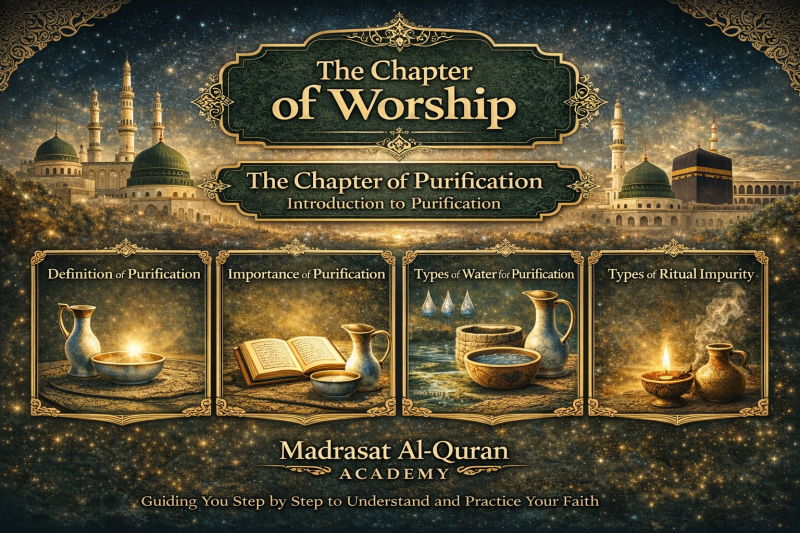
Purification
The Chapter of Purification
Lesson One: Definition of Purification, Its Importance, Types of Water, and Types of Ritual Impurity
First: Definition of Purification
Linguistic Meaning
Purification means cleanliness and freedom from impurities.
Islamic Definition
Purification means removing ritual impurity and removing physical impurity.
This includes:
Removing physical impurities from the body, clothes, or place
Or lifting ritual impurity through wudu, ghusl, or tayammum
Second: The Importance of Purification in Islam
Purification is not merely cleanliness; it is an act of worship through which a Muslim draws closer to Allah.
The Prophet ﷺ said:
"Purification is half of faith."
Allah تعالى says:
"Indeed, Allah loves those who repent and loves those who purify themselves."
Purification is:
A condition for the validity of prayer
The key to all acts of worship
A sign of complete faith
A cause for earning Allah’s love
No prayer, tawaf, or touching the Mushaf is valid without purification.
Third: Types of Purification
Purification is divided into two main types:
1) Physical Purification
This is the removal of physical impurity from:
The body
Clothing
The place
Such as removing urine, blood, or other impurities.
2) Ritual Purification
This is the removal of ritual impurity through:
Wudu
Ghusl
Or tayammum when water is unavailable
Fourth: Definition of Ritual Impurity (Hadath)
Linguistic Meaning
Hadath means something that occurs or happens.
Islamic Definition
Hadath is a spiritual state that prevents a person from performing prayer, tawaf, and touching the Mushaf until purification is performed.
Fifth: Types of Ritual Impurity
Ritual impurity is divided into two types:
1) Minor Ritual Impurity
This requires wudu to be removed.
Examples include:
Anything that exits from the private parts (urine, stool, wind)
Deep sleep
Loss of consciousness due to fainting or intoxication
Touching the private parts directly according to some scholars
Minor impurity is removed by: Wudu or tayammum when water is unavailable.
2) Major Ritual Impurity
This requires ghusl to be removed.
Its causes include:
Janabah (sexual impurity)
Menstruation
Post-natal bleeding
Major impurity is removed by: Ghusl or tayammum when water is unavailable.
Sixth: Types of Water Used for Purification
1) Purifying Water (Pure and Purifying)
This is water that is pure in itself and purifies others. It is valid for wudu, ghusl, and removing impurity.
Examples include:
Rainwater
Sea water
River water
Well water
Spring water
Melted snow and hail
The Prophet ﷺ said about sea water:
"Its water is pure and its dead animals are lawful."
2) Pure but Not Purifying Water
This is water that is pure in itself but cannot remove ritual impurity.
Examples include:
Water used previously for wudu or ghusl
Water that has changed significantly due to a pure substance
3) Impure Water
This is water that has been contaminated by impurity which changed its:
Color
Taste
Or smell
This water is not permissible for purification.
An Important Jurisprudential Principle
The original ruling regarding water is purity, and it is not considered impure unless one of its characteristics changes due to impurity.
Lesson Summary
Purification is a great act of worship
Purification is of two types: physical and ritual
Ritual impurity prevents acts of worship
Ritual impurity is of two types: minor and major
Purifying water is the foundation of purification
The original ruling regarding water is purity unless proven otherwise
Madrasat Al-Quran
We guide you step by step to understand your religion and worship with clarity
Because worship is knowledge before action