

The Science Behind Quran Recitation
Quran recitation is not only a spiritual act of worship. It is also a unique linguistic and acoustic experience that affects the human mind and body in remarkable ways.
For centuries, Muslims have recognized the calming and transformative effect of Quran recitation. Today, modern research in neuroscience, psychology, and sound studies provides deeper insight into why Quran recitation has such a powerful impact.
Understanding the science behind Quran recitation helps us appreciate its beauty, structure, and influence even more.
1. The Unique Rhythm of Quranic Language
One of the most remarkable aspects of the Quran is its rhythmic structure.
Unlike ordinary speech, Quranic verses combine:
precise phonetic patterns
balanced syllable structures
natural rhythmic flow
This rhythmic harmony makes Quran recitation both memorable and emotionally powerful.
Many scholars describe the Quran as possessing a distinct acoustic architecture, where sound patterns contribute to both meaning and impact.
2. The Brain's Response to Quran Recitation
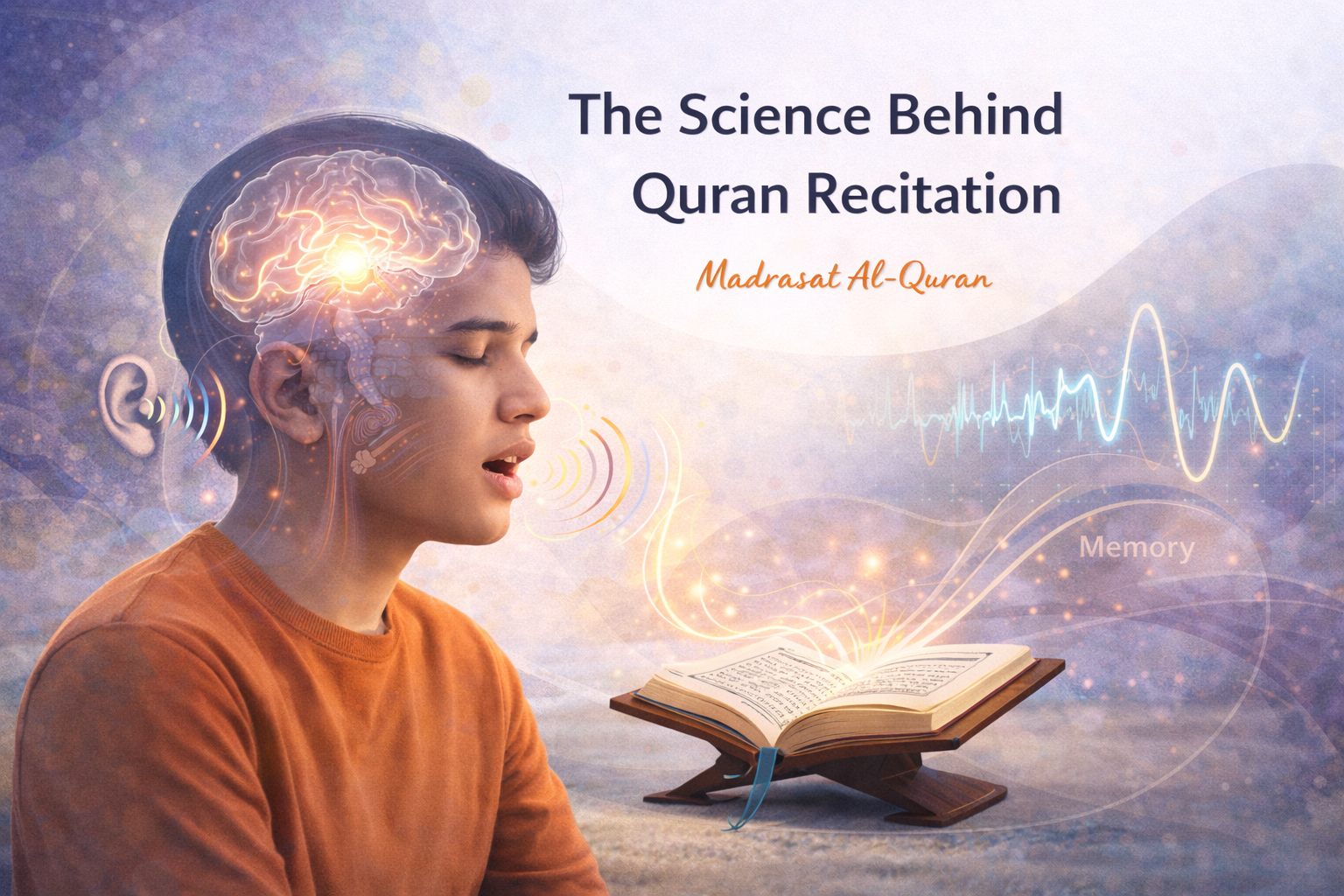
Scientific studies on auditory processing show that rhythmic and melodic sound patterns stimulate multiple areas of the brain.
When listening to Quran recitation:
the auditory cortex processes the sound
the emotional centers of the brain respond to tone and melody
memory-related regions become active
This explains why many listeners experience feelings of calmness, focus, and emotional connection during Quran recitation.
In some studies, Quran recitation has been associated with reduced stress levels and improved mental relaxation.
3. Repetition and Memory Formation
The Quran uses repetition in meaningful and structured ways.
This repetition serves several purposes:
strengthening memorization
reinforcing meaning
enhancing rhythmic balance
From a cognitive perspective, repetition is one of the most powerful mechanisms for long-term memory formation.
This is one reason why millions of Muslims successfully memorize the Quran.
4. The Role of Tajweed in Sound Precision
Tajweed rules are not merely stylistic traditions.
They represent a highly refined system of phonetic precision.
Tajweed regulates:
articulation points of letters
elongation of sounds (Madd)
nasal resonance (Ghunnah)
pauses and stopping points
These elements ensure that the Quran is recited exactly as it was transmitted through generations.
From a linguistic perspective, Tajweed preserves both clarity and acoustic beauty.
5. Emotional and Psychological Impact
Beyond its linguistic structure, Quran recitation has a profound emotional influence.
Many listeners report:
increased tranquility
spiritual awareness
improved concentration
The combination of meaning, rhythm, and vocal modulation creates a deeply immersive experience.
This emotional resonance is one reason why Quran recitation remains central to Muslim spiritual life.
The Role of Proper Learning
While listening to Quran recitation is beneficial, learning to recite correctly unlocks a deeper connection with the text.
Proper instruction allows learners to:
pronounce letters accurately
apply Tajweed rules correctly
develop confidence in recitation
Guided learning transforms recitation from simple reading into a disciplined and beautiful practice.
How Madrasat Al-Quran Helps Students Master Recitation
At Madrasat Al-Quran, we combine traditional Quranic teaching methods with structured learning approaches.
Our programs focus on:
correct pronunciation of Arabic letters
systematic Tajweed training
guided recitation practice
personalized instruction
Students receive continuous feedback from experienced teachers, helping them improve both accuracy and fluency.
The goal is not only to read the Quran—but to experience the beauty of its recitation.
Conclusion
Quran recitation is a unique intersection of spirituality, language, and sound science.
Its rhythmic structure, phonetic precision, and emotional depth make it one of the most powerful forms of spoken expression.
By understanding the science behind Quran recitation, we gain a deeper appreciation for its design and its impact on the human mind.
And through proper learning and practice, every student can experience the beauty and clarity of Quranic recitation.