

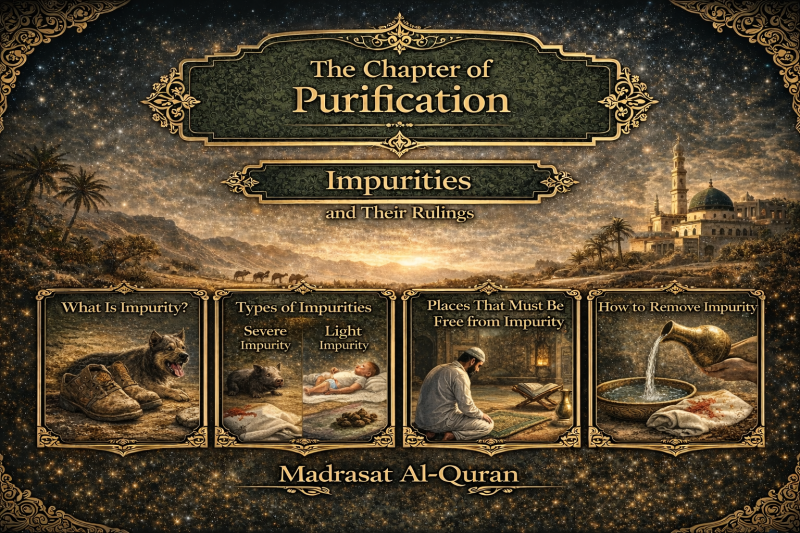
Impurities
The Chapter of Purification
Impurities and Their Rulings
Purification in Islam is not limited to wudu and ghusl only.
It also includes purity of the body, purity of clothing, and purity of the place.
Prayer is not valid unless all three are free from impurity.
First: What Is Impurity?
Linguistic Meaning
Impurity means filth or uncleanness.
Islamic Definition
Impurity is any substance deemed impure by Islamic law whose presence prevents the validity of prayer and must be removed.
In other words, anything that Islamic law rules as impure must be cleansed if it is found on the body, clothing, or place of prayer.
Second: Types of Impurities
Scholars classified impurities into categories to make it easier to understand how they are purified:
1) Severe Impurity
This is the most serious type of impurity.
Examples:
Dog and pig impurity
How to purify it:
Washing seven times
One of them with soil (or something that serves the same purpose)
2) Light Impurity
This type has a lighter ruling.
Example:
Urine of a male infant who has not yet eaten solid food
How to purify it:
Sprinkling water over it without scrubbing or squeezing
3) Moderate Impurity
This includes most impurities.
Examples:
Urine
Feces
Blood
Vomit
Madhy and wady
How to purify it:
Washing the affected area until the impurity itself is removed
Third: Places That Must Be Free from Impurity
Impurity must be removed from:
The body
Clothing
The place of prayer
Prayer is not valid if impurity is present in any of these.
Fourth: How to Remove Impurity
The basic means of removing impurity is pure water.
Conditions include:
The impurity itself must be removed
Its color, taste, or smell should disappear if possible
No specific number of washes is required except in cases of severe impurity.
Fifth: Excused (Forgiven) Impurities
Out of Allah’s mercy, some minor impurities that are difficult to avoid are excused.
Examples include:
A small amount of blood
Mud mixed with impurity on roads
Impurities that are not visible to the naked eye
Sixth: Doubt Regarding Impurity
An important jurisprudential rule:
The original ruling of things is purity.
If someone:
Doubts whether impurity touched their clothing
Or doubts whether a place is impure
The default ruling is that it is pure, and doubt does not remove certainty.
Seventh: The Difference Between Ritual Impurity and Physical Impurity
Ritual Impurity (Hadath):
A spiritual state that prevents prayer and is removed by wudu, ghusl, or tayammum.
Physical Impurity (Najasah):
A tangible substance that must be removed by washing and cleaning.
Summary of Impurities
Impurity prevents the validity of prayer
Impurities are classified into severe, light, and moderate
The body, clothing, and place must be purified
Water is the primary means of purification
Doubt does not invalidate purity
Madrasat Al-Quran
We teach Islam with understanding and reassurance
Because purity is the foundation of worship, and correct actions begin with correct knowledge