

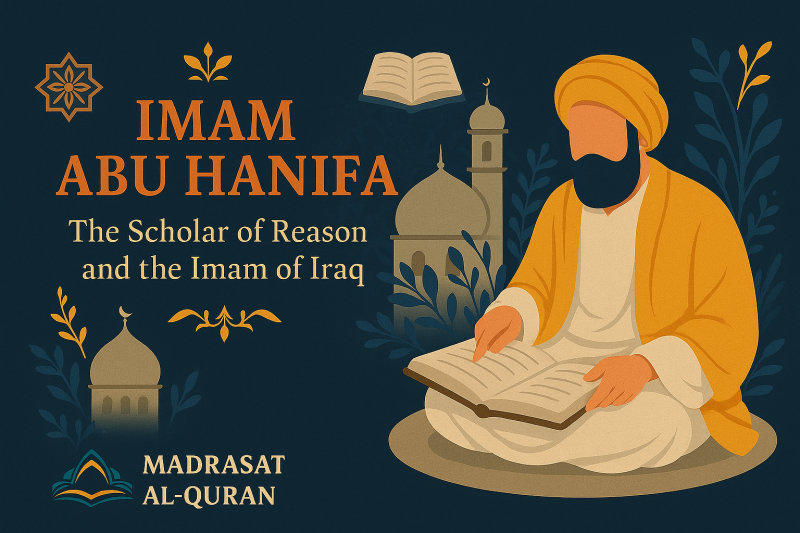
Imam Abu Hanifa al-Nu‘man
Imam Abu Hanifa al-Nu‘man
The Scholar of Reason and the Imam of Iraq
In the midst of turbulent times and intellectual cities, there emerged a man who was not just a scholar, but a school in himself.
He is Imam Abu Hanifa al-Nu‘man ibn Thabit, the first of the four great Imams and the founder of the Hanafi school of thought—the earliest and most widespread in the Muslim world.
---
🌟 Who Was He?
Born in Kufa in the year 80 AH (699 CE) to a family of Persian origin, his father had met companions of the Prophet ﷺ, making Abu Hanifa a generation removed from the Sahabah.
At first, he wasn’t a scholar—he was a textile merchant. But everything changed when he encountered the great scholar al-Sha‘bi, who said to him:
> “I see intelligence and potential in you. Seek knowledge!”
From that day, his life’s mission changed.
---
📘 His Journey in Seeking Knowledge
He studied under Hammad ibn Abi Sulayman for over 18 years.
He took hadith from notable Tabi‘in such as Ata’ ibn Abi Rabah, Nafi‘ the freed slave of Ibn Umar, and more.
He interacted with Imam Malik and Imam Ja‘far al-Sadiq, from whom he benefited greatly.
He pioneered the integration of hadith and reason, and introduced analogy (qiyas) as a major legal method in Islamic jurisprudence.
---
✨ His Striking Character
He was composed, wise, and a man of few but weighty words.
Known for his deep piety, he refused payment for fatwas or teaching.
When offered the position of chief judge by the Abbasid caliph al-Mansur, he declined. As a result, he was imprisoned and beaten—but he remained steadfast.
Even in prison, he would fast during the day, pray at night, and teach students.
Abu Yusuf said:
> “I have never seen anyone more knowledgeable, intelligent, or devout than Abu Hanifa.”
---
🧠 His Balanced Approach to Fiqh
Imam Abu Hanifa was a pioneer of legal philosophy and rational deduction. His approach was:
✅ The Qur’an first
✅ Then well-known and widely accepted Sunnah
✅ Then analogical reasoning (qiyas)
✅ Then juristic preference (istihsan)
✅ He also considered custom (‘urf) and Companion opinions when necessary.
Imam al-Shafi‘i said:
> “Whoever wants to dive deep into fiqh, they are all dependent on Abu Hanifa.”
---
📚 Famous Incidents & Wisdom
Once he was asked about a legal matter with 60 variations. He answered every one with detailed reasoning.
A man asked him: “What do you say about someone who misses ‘Asr prayer until the sun sets?”
He replied: “He should perform it immediately before any other prayer.”
The man said: “Isn’t that out of sequence?”
Abu Hanifa responded:
> “No, it is honoring the right that came first before attending to the next.”
Even in prison, he continued to teach students and issue answers to pressing legal questions.
---
👨🏫 His Students
His students became the pillars of the Hanafi school:
Abu Yusuf, the first Chief Judge in Islamic history
Muhammad ibn al-Hasan al-Shaybani, who compiled and expanded the school’s teachings
Later figures like al-Tahawi and al-Marghinani preserved and refined the madhhab
---
⚖️ The Spread of Hanafi Madhhab
It became the official madhhab in:
The Abbasid Caliphate
The Ottoman Empire
India, Pakistan, the Balkans, Central Asia, and beyond
Today, it is one of the most followed schools of Islamic jurisprudence.
---
🕊️ His Passing
He passed away in Baghdad in 150 AH—the same year Imam al-Shafi‘i was born.
Tens of thousands attended his funeral, praying in waves over his body. Some narrations mention 50,000 people.
---
✨ Want to Learn the Hanafi School?
At Madrasat Al-Quran, we offer a dynamic and authentic approach to studying the legacy of Imam Abu Hanifa:
🎓 What We Offer:
✅ Simplified and in-depth courses on Hanafi fiqh
✅ Comparative studies of the four madhhabs
✅ Live, interactive sessions with certified scholars
✅ Customized programs for adults, youth, and beginners
✅ Flexible schedules for students, parents, and professionals
📍 Don’t miss the opportunity to connect with the intellectual and spiritual depth of our rich Islamic heritage.
Start your journey today with Madrasat Al-Quran—
🌿 Where classical knowledge meets modern learning.