

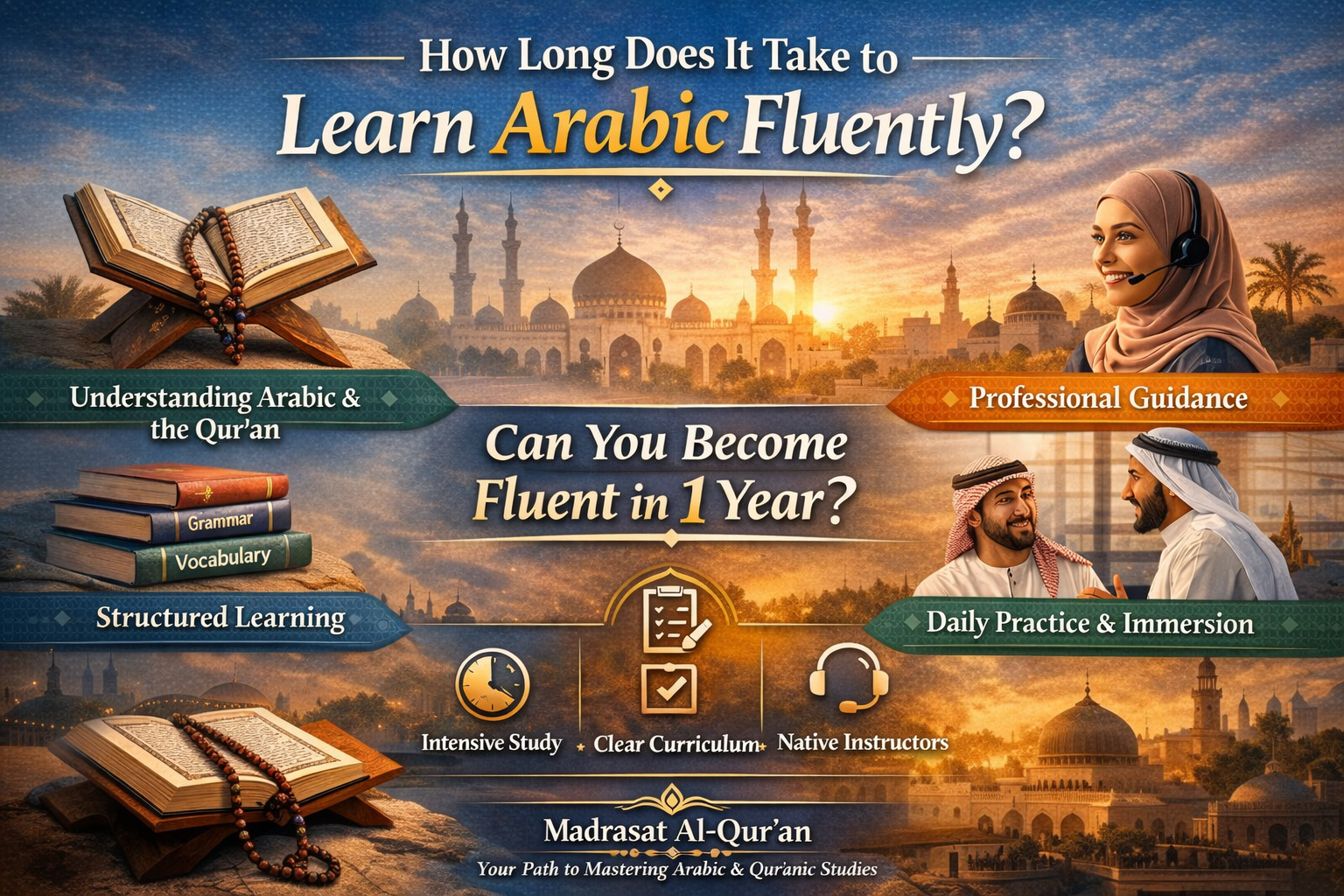
How Long Does It Take to Learn Arabic Fluently?
Learning Arabic fluently is a profound intellectual journey with a deep spiritual dimension. Whether your goal is academic excellence, professional communication, or a deeper understanding of the Qur’an, one common question arises: How long does it actually take?
The answer is not tied to a fixed number. It depends on linguistic, cognitive, and methodological factors. With proper planning and consistent effort, fluency becomes a realistic and achievable goal.
What Does “Fluency” in Arabic Mean?
In linguistic terms, fluency refers to:
The ability to understand spoken Arabic in various contexts
Expressing thoughts clearly and smoothly
Possessing effective reading and writing skills
Understanding proper usage and grammatical structures
In Arabic specifically, fluency may involve:
Modern Standard Arabic for academic and formal settings
A regional dialect for everyday communication
Classical Arabic for understanding Islamic texts and the Qur’an
Each path carries its own learning characteristics and progression.
Why Does Arabic Require a Structured Approach?
Arabic has distinctive linguistic features, including:
A unique writing system
A root-based (triliteral) structure
Diverse verb patterns
Detailed grammatical inflection
Diglossia (formal Arabic and dialects)
These features do not make Arabic impossible to learn — they simply require a clear and progressive methodology.
What Determines How Fast You Become Fluent?
1️⃣ Structured Learning
Random learning slows progress. A guided curriculum accelerates it.
2️⃣ Consistency
Daily commitment — even for a short time — is more powerful than irregular study.
3️⃣ Instructor Quality
A qualified teacher corrects mistakes early and prevents long-term confusion.
4️⃣ Practical Application
Listening and speaking transform theory into real skill.
5️⃣ Clear Purpose
Learners with a defined goal (academic, professional, or religious) tend to progress more efficiently.
Can You Become Fluent Within a Year?
In some cases, yes — especially with intensive and disciplined study.
However, what matters more than speed is the strength of the foundation.
True fluency is not just memorizing vocabulary; it is understanding the structure of the language and thinking in it.
The Special Nature of Learning Arabic for the Qur’an
Learning Arabic to understand the Qur’an requires:
Mastery of classical structures
Contextual understanding of Qur’anic vocabulary
Awareness of rhetorical styles
Proper pronunciation through Tajweed
This path combines linguistic development with spiritual growth, making it uniquely rewarding.
Why Choose Madrasat Al-Quran?
At Madrasat Al-Quran, we do not offer traditional language lessons — we design a complete educational journey.
We provide:
Structured Arabic programs from beginner to advanced
A specialized Qur’anic Arabic track
Certified native instructors
Interactive one-on-one classes
Personalized progress tracking
Integrated Tajweed training for accurate pronunciation from the beginning
We believe effective learning is not about rushing — it is about building a strong, confident foundation.
Final Thought
Learning Arabic fluently is not defined by a specific timeline. It is defined by structure, consistency, and the right learning environment.
Start with a guided step today — and let Arabic become your gateway to deeper understanding, wider communication, and a closer connection to the Qur’an.