From Baghdad to the World: The Journey of Arabic Numerals
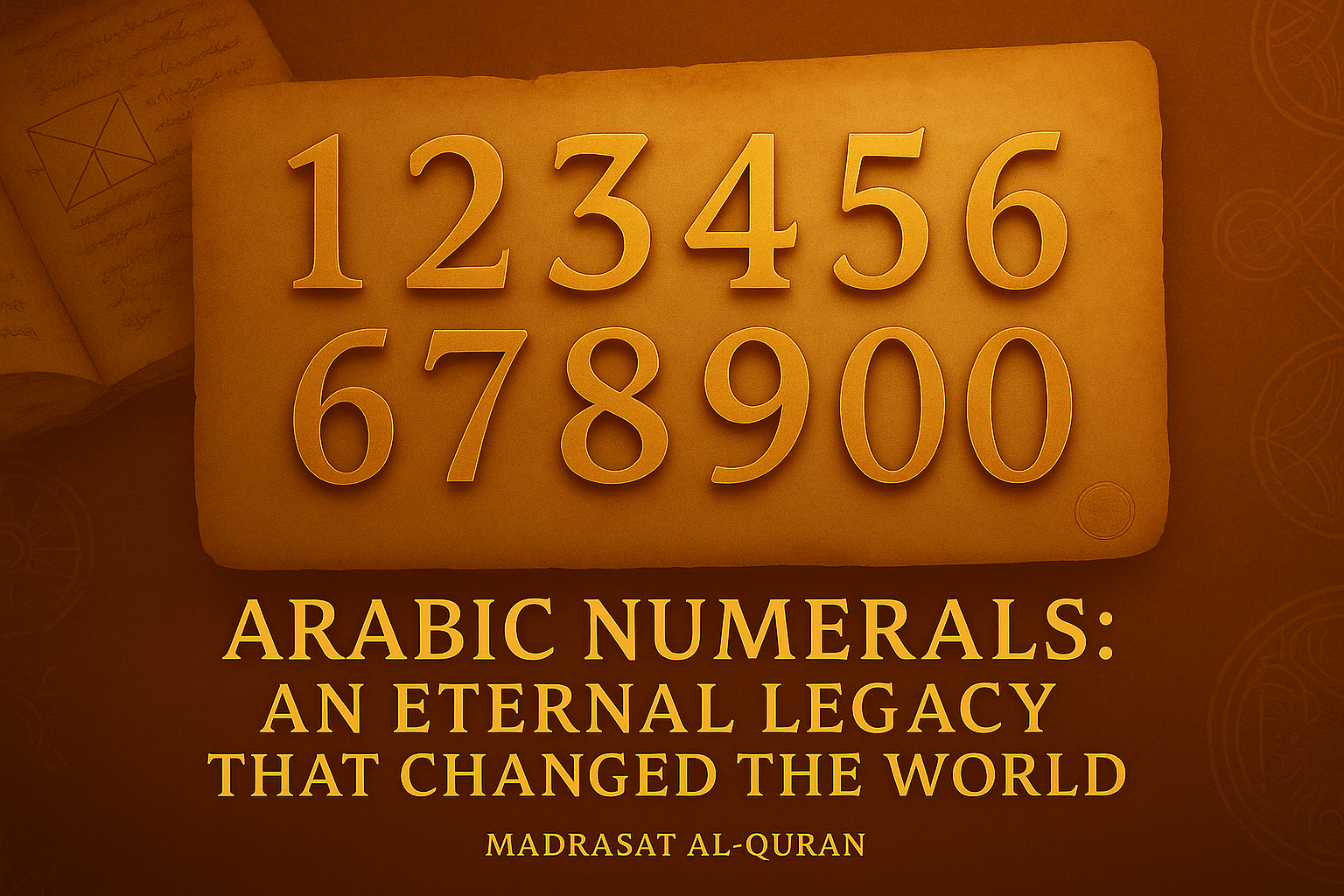
Arabic Numerals: An Eternal Legacy that Changed the World
Introduction: The Language of Numbers that Never Dies
When you look at your phone, count your money, or write a date in your calendar, you are using Arabic numerals that Muslims gifted to the world. They are not just symbols, but a universal language born in our Islamic civilization, spreading from Baghdad, Damascus, and Cordoba to Europe, becoming the foundation of mathematics and modern science.
---
From Islamic Civilization to Europe
The Abbasid Era: Science flourished in Baghdad’s House of Wisdom, where scholars developed the decimal system.
Al-Khwarizmi: The mathematician who wrote works on algebra and arithmetic, laying the foundations of algebra and transmitting Arabic numerals to the West.
Al-Andalus: The bridge through which this knowledge entered Europe, where Arabic works were translated into Latin, sparking a scientific revolution that reshaped history.
---
Why Did Arabic Numerals Revolutionize the World?
1. The invention of zero: A genius idea that made complex calculations possible and allowed advanced sciences to emerge.
2. Simplicity and flexibility: Roman numerals were complicated; Arabic numerals made calculations faster and easier.
3. Foundation for algebra and geometry: Without them, great scientists like Newton could not have developed their theories.
4. A universal language: Today Arabic numerals are used everywhere—from technology to global economics.
---
The Impact of Arabic Numerals on Scientific Progress
They advanced astronomy, enabling accurate calculations of planetary positions.
They facilitated inheritance and zakat calculations in line with Islamic law.
They became the basis for accounting and economics, sustaining global trade.
Without them, inventions like the computer or artificial intelligence would not have been possible.
---
Arabic Numerals and the Qur’an
Muslim interest in numbers was not limited to mathematics—it was deeply tied to faith:
Prayer times are determined through astronomical calculations.
Zakat and charity require precise accounting.
The Islamic calendar relies on lunar calculations.
Thus, numbers were integrated into worship, making science a servant of religion.
---
Frequently Asked Questions
1. Are the numbers we use today Arabic or Indian?
They originated in India, but Muslim scholars developed them, added the zero, perfected the decimal system, and spread them worldwide. That is why they are universally known as Arabic Numerals.
2. How did they reach Europe?
Through Al-Andalus, Sicily, and the translation of works by scholars such as Al-Khwarizmi and Al-Biruni.
3. Are Arabic numerals still used today?
Yes—they are the foundation of science, technology, and economics across the globe.
---
Conclusion: A Legacy That Lives On
Arabic numerals are not just signs we write; they are an eternal legacy that Muslims left for humanity—an achievement that enabled the world to calculate, invent, and build entire civilizations on knowledge and mathematics.
---
Your Journey with Madrasat Al-Quran
At Madrasat Al-Quran, we teach not only Qur’an and Arabic, but also reconnect students with the legacy of their civilization.
We inspire learners to appreciate the Muslim contribution to world science.
We cultivate pride in the achievements of our ancestors.
We show that science and the Qur’an are two paths that walk together.
Start your journey with us today. Learn the language of the Qur’an and the legacy of a nation that transformed the world.