

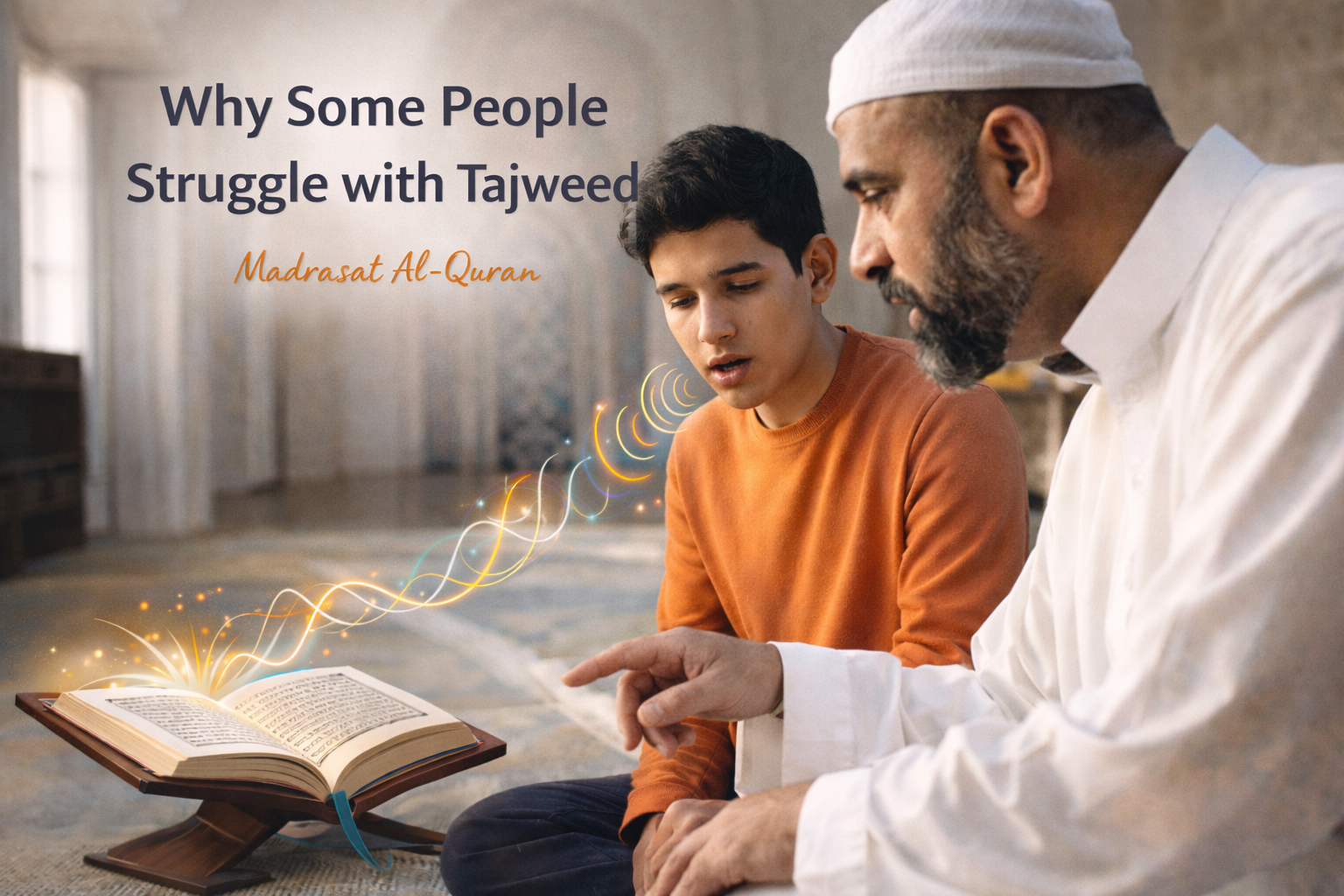
Why Some People Struggle with Tajweed
Learning Tajweed—the science of correctly reciting the Quran—is an essential part of Quranic education. Yet many learners find themselves struggling with Tajweed even after years of reading the Quran.
This challenge does not necessarily reflect a lack of intelligence or dedication. Instead, it often results from linguistic, educational, and methodological factors.
Understanding these challenges is the first step toward overcoming them.
1. Influence of One’s Native Language
One of the most significant reasons people struggle with Tajweed is the influence of their native language.
Every language has its own sound system. When learners approach Arabic recitation, they often unconsciously apply the pronunciation patterns of their first language.
For example:
Some languages do not contain deep throat sounds like ع (‘Ayn) or ح (Ha).
Others do not distinguish between heavy and light letters such as ص and س.
As a result, learners may read the Quran fluently while still mispronouncing certain letters.
Tajweed requires retraining the mouth, tongue, and throat to produce sounds unfamiliar to many learners.
2. Lack of Early Pronunciation Training
Another common challenge is the absence of proper pronunciation training in the early stages of learning.
Many students begin by memorizing words or verses without fully mastering the articulation points of Arabic letters (Makharij).
Over time, incorrect pronunciation becomes a habit.
Correcting such habits later requires conscious effort and consistent practice.
This is why foundational Tajweed training is essential before advancing in Quran recitation.
3. Confusion Between Reading and Reciting
Many learners assume that the ability to read Arabic automatically means they can recite the Quran correctly.
However, reading Arabic text and reciting the Quran according to Tajweed rules are two different skills.
Tajweed involves:
Precise articulation
Proper elongation (Madd)
Nasal sounds (Ghunnah)
Correct stops and pauses (Waqf)
Without structured training, these elements are often overlooked.
4. Limited Feedback During Recitation
Learning Tajweed requires continuous correction.
When students practice alone without feedback, mistakes may go unnoticed.
Over time, these small errors accumulate and become ingrained habits.
Guided recitation with a qualified teacher allows learners to receive immediate correction and refine their pronunciation gradually.
5. Psychological Barriers and Lack of Confidence
Some learners hesitate to practice Tajweed out loud due to fear of making mistakes.
This hesitation slows progress significantly.
Tajweed is a practical skill that develops through repeated vocal practice.
Confidence grows when learners practice in a supportive and encouraging environment.
Practical Steps to Improve Tajweed
Overcoming Tajweed difficulties is entirely possible with the right approach.
Effective strategies include:
Learning the articulation points of letters step by step
Listening to skilled Quran reciters regularly
Practicing recitation slowly and carefully
Recording and reviewing one's recitation
Studying with a qualified teacher
Consistency and guided practice gradually transform recitation quality.
How Madrasat Al-Quran Helps Students Master Tajweed
At Madrasat Al-Quran, Tajweed learning is approached systematically and patiently.
Our programs focus on:
Step-by-step articulation training
One-on-one recitation correction
Practical Tajweed application
Personalized learning pace
Students receive continuous feedback from experienced teachers, helping them replace incorrect habits with accurate recitation.
The goal is not simply to read the Quran—but to recite it beautifully and correctly, as it was revealed.
Conclusion
Struggling with Tajweed is a common experience for many learners, especially those approaching Quran recitation from different linguistic backgrounds.
However, with structured guidance, consistent practice, and proper instruction, these challenges can be overcome.
Tajweed is not merely a technical discipline—it is a means of honoring the Quran and preserving the beauty of its recitation.
And with the right support, every learner can achieve clarity, confidence, and precision in Quran recitation.