

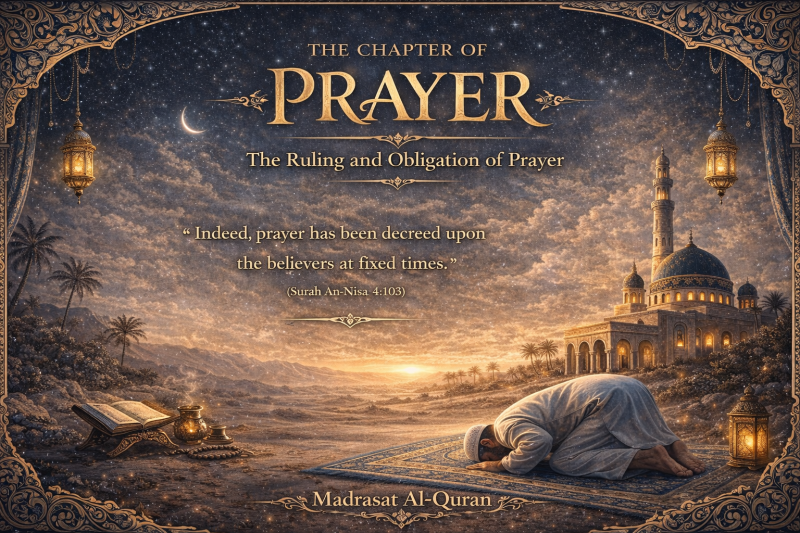
The Ruling and Obligation of Prayer
The Chapter of Prayer
The Ruling and Obligation of Prayer
Prayer is not optional in a Muslim’s life,
nor a voluntary act that may be neglected without consequence.
Rather, it is the greatest practical obligation in Islam,
and the first act of worship made obligatory after faith.
First: The Ruling of Prayer in Islam
Prayer is an individual obligation (Fard ‘Ayn) upon every Muslim who is:
Adult
Sane
Male or female,
resident or traveler,
healthy or ill — each according to their ability.
Prayer is never dropped from a Muslim as long as the mind is present.
Allah says:
“Indeed, prayer has been decreed upon the believers at fixed times.”
Meaning:
It is a firm obligation, tied to specific times, and not open to negligence.
Second: How Was Prayer Made Obligatory?
Prayer holds a unique status among acts of worship.
It was not prescribed on earth
It was not revealed through ordinary means
Rather:
It was obligated above the seven heavens
During the Night Journey and Ascension (Isra’ and Mi‘raj)
It was first prescribed as fifty prayers,
then reduced to five,
while the reward remained equal to fifty.
This shows:
The عظَمة (greatness) of prayer
Its high rank with Allah
Allah’s mercy toward His servants
Third: Why Is Prayer the Greatest Obligation After Faith?
Because prayer is:
The pillar of religion
The daily connection between the servant and his Lord
The only act of worship repeated every day and night
The Prophet ﷺ said:
“The head of the matter is Islam, and its pillar is prayer.”
If the pillar falls,
the entire structure collapses.
Fourth: The Status of Prayer Among Other Acts of Worship
Prayer:
Takes precedence over all other deeds
Determines the acceptance of all actions
Is the true measure of righteousness
The Prophet ﷺ said:
“The first deed for which a servant will be held accountable on the Day of Judgment is prayer.”
If it is sound, all other deeds are sound.
If it is corrupt, all other deeds are corrupt.
Fifth: The Ruling on One Who Abandons Prayer
A person who abandons prayer falls into two categories:
1) One who abandons it while denying its obligation
This is disbelief by scholarly consensus,
because it is a denial of something known necessarily in Islam.
2) One who abandons it out of laziness or neglect
While believing it is obligatory
This is among the greatest and most dangerous sins.
Some scholars held that such a person disbelieves,
while the majority held that he commits a grave sin and is in serious danger.
The Prophet ﷺ said:
“The covenant between us and them is prayer; whoever abandons it has disbelieved.”
Sixth: Does Prayer Ever Fall Away?
Prayer:
Does not fall away except with the loss of intellect
Is never abandoned under any circumstance
Even:
The sick person prays according to ability
The traveler prays with concessions
The fearful prays the prayer of fear
Because prayer is a connection that never breaks.
Seventh: The Obligation of Prayer Is Mercy, Not Hardship
Prayer was not prescribed to burden the believer,
but to be:
Comfort for the soul
Relief for distress
A daily spiritual reset
The Prophet ﷺ said:
“Give us comfort through it, O Bilal.”
Meaning:
Prayer is relief — not burden.
Summary: The Obligation of Prayer
Prayer is an individual obligation upon every Muslim
It was prescribed above the heavens due to its great status
It is the pillar of religion and the first deed accounted for
It never falls away
Abandoning it is a grave danger to faith
Madrasat Al-Quran
We teach why Allah obligated prayer
before teaching how to perform it
Because correct understanding is the foundation of correct worship