

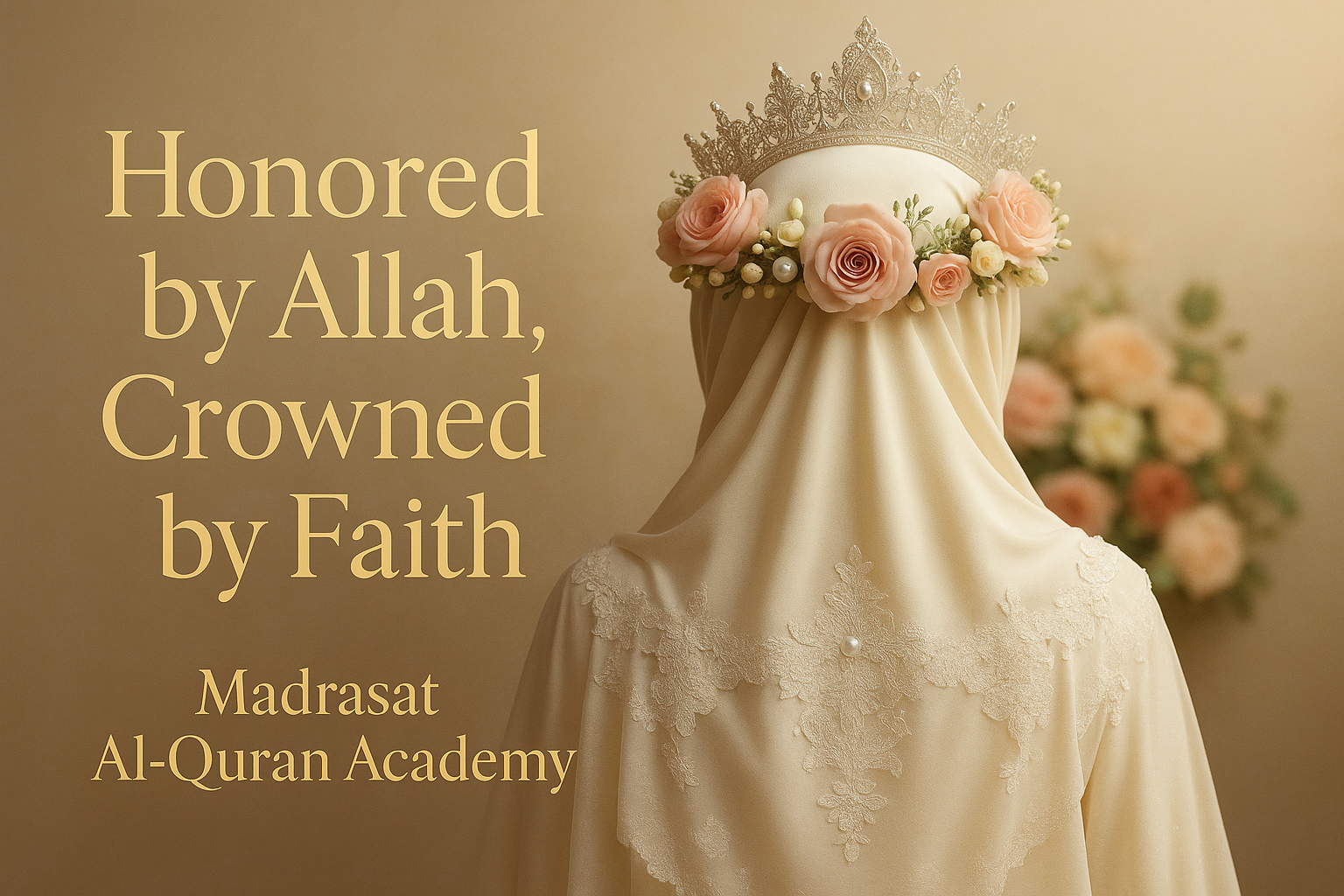
“She Is Light – The Honor of Women in Islam”
Women in Islam: Dignity Preserved and Honor Elevated
From the dawn of Islam, women were honored, respected, and valued — not as commodities to be used, nor as voices to be silenced, but as souls of purity and pillars of compassion, forming the foundation of families and the heart of society.
Islam came to liberate her from the injustice of ignorance, to restore her dignity, and to remind the world that her worth is not determined by appearance or status, but by faith and piety.
> “And We have certainly honored the children of Adam.”
(Surah Al-Isra, 17:70)
This divine honor applies to both men and women alike, for Islam judges not by gender or wealth, but by righteousness.
---
Before and After Islam
Before the rise of Islam, women suffered humiliation and oppression.
They were treated as property, denied education, and even buried alive out of fear or shame.
Then came Islam — a light that illuminated hearts and societies alike.
It made her a mother beneath whose feet lies Paradise,
a wife who completes her husband’s faith,
and a daughter through whom the doors of Paradise are opened.
The Prophet Muhammad ﷺ said:
> “Treat women kindly.”
(Al-Bukhari & Muslim)
With these few words, Islam established a timeless principle:
The dignity of a woman is not a favor granted by society; it is a divine right.
---
The Rights of Women in Islam
Islam restored to women every right they were denied for centuries.
1. The Right to Education:
Knowledge is a duty for every Muslim man and woman.
Aisha bint Abu Bakr was among the greatest scholars of her time; companions and jurists would seek her counsel in matters of faith and law.
2. The Right to Property and Inheritance:
The Qur’an clearly states:
> “For men is a share of what they have earned, and for women is a share of what they have earned.”
(Surah An-Nisa, 4:32)
3. The Right to Choose Her Spouse:
Islam forbids forcing a woman into marriage.
The Prophet ﷺ annulled the marriage of a woman who was wed against her will.
4. The Right to Work with Dignity:
A woman may work honorably within the bounds of modesty and benefit to society.
Al-Shifa bint Abdullah was a physician and educator during the Prophet’s time, appointed by Caliph Umar to supervise the marketplace — a role of great responsibility.
5. The Right to Participate in Society:
Women contributed to Islamic life from its earliest days.
Asma bint Abu Bakr assisted in the Hijrah (Migration), courageously providing food and supplies to the Prophet ﷺ and her father while they hid in the cave of Thawr.
---
Inspiring Examples of Women in Early Islam
Khadijah bint Khuwaylid – The First Believer and Supporter
A successful businesswoman and a woman of wisdom, Khadijah believed in the Prophet ﷺ when no one else did.
She supported him with her wealth, comfort, and trust.
The Prophet ﷺ said:
> “She believed in me when others disbelieved; she helped me with her wealth when others withheld.”
---
Aisha bint Abu Bakr – The Scholar of the Ummah
Aisha was among the most knowledgeable scholars of Islam.
She narrated over 2,000 hadiths and was a reference for companions in jurisprudence, worship, and even medicine.
She embodied the balance of knowledge, modesty, and influence.
---
Asma bint Abu Bakr – The Woman of Courage
Known as “the one with the two belts”, Asma demonstrated courage and devotion during the Prophet’s migration.
She risked her life to serve the Prophet ﷺ and raised her son, Abdullah ibn al-Zubair, upon the values of honor and bravery.
---
Al-Shifa bint Abdullah – The Physician and Educator
One of the earliest educated women in Islam, Al-Shifa practiced medicine and taught literacy to others.
Caliph Umar ibn al-Khattab appointed her to oversee public affairs in the market — proof of the trust and respect women held in early Islamic society.
---
Nusaybah bint Ka’ab (Umm Ammarah) – The Defender of the Prophet ﷺ
A symbol of bravery, Umm Ammarah fought in the Battle of Uhud, shielding the Prophet ﷺ with her body.
She sustained multiple wounds and never retreated.
The Prophet ﷺ said:
> “Wherever I turned during the battle of Uhud, I saw her fighting to protect me.”
---
The Woman: The Heart and Soul of the Ummah
In Islam, the woman is not a shadow behind man — she is the foundation beside him.
She is the mother who nurtures, the teacher who enlightens, the believer who endures, and the companion who strengthens.
> “Whoever does righteous deeds, whether male or female, while being a believer — they will enter Paradise.”
(Surah An-Nisa, 4:124)
When a woman is honored, a nation is elevated.
When she is oppressed, a civilization falls.
---
At Madrasat Al-Quran Academy
At Madrasat Al-Quran Academy, we teach our girls that true strength lies in faith,
true beauty in character,
and true honor in knowledge and virtue.
We nurture a generation of young women who follow the legacy of Khadijah’s devotion, Aisha’s knowledge, Asma’s courage, and Al-Shifa’s leadership —
women who carry the Qur’an in their hearts, wisdom in their minds, and mercy in their souls.
At Madrasat Al-Quran, we teach that a woman’s worth is not measured by her appearance,
but by her faith, knowledge, and the light she brings to others.