

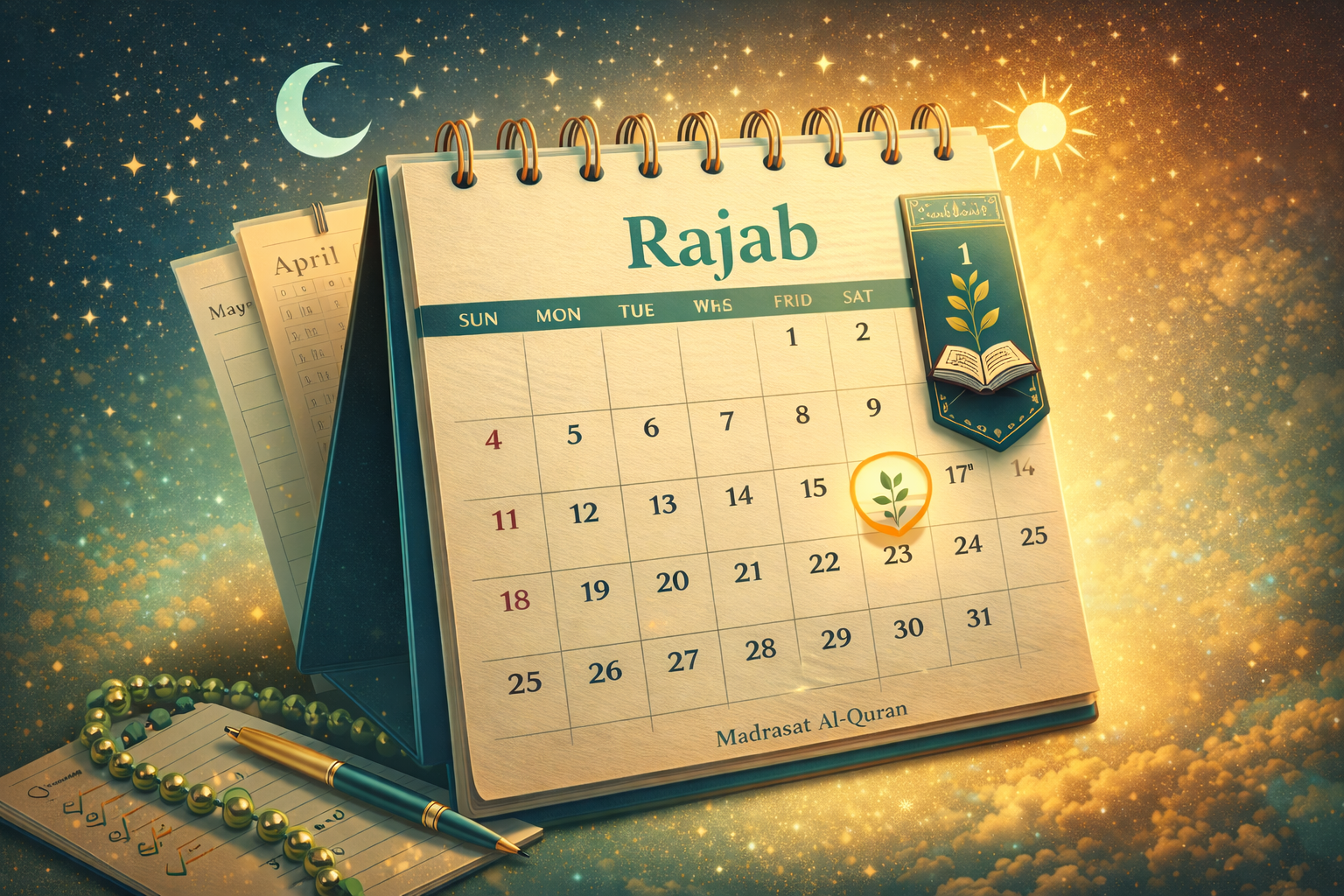
Rajab: The Gateway to the Great Seasons
The Month of Rajab and Its Virtue
A Spiritual Station Before the Great Seasons of Worship
The month of Rajab comes each year as a gentle reminder that the journey to Allah is not a single moment, but a process of preparation, gradual growth, and sincere readiness. It is one of the sacred months that Allah has honored and given a special place in the balance of time.
Allah says:
“Indeed, the number of months with Allah is twelve months in the Book of Allah… of them, four are sacred.”
(Qur’an 9:36)
Scholars have unanimously agreed that these four sacred months are: Dhu al-Qa‘dah, Dhu al-Hijjah, Muharram, and Rajab.
Why Is Rajab Called Rajab?
The name Rajab comes from tarjīb, meaning reverence and honor. The Arabs in the pre-Islamic era used to honor this month, and Islam affirmed its sanctity—while regulating it with clear guidance based on revering obedience and avoiding wrongdoing, not cultural rituals or unfounded practices.
The Virtue of the Month of Rajab
The virtue of Rajab is firmly established by the fact that it is:
A sacred month
A time when good deeds are magnified
A time when injustice and sin are more severely warned against
Scholars have stated:
Righteous deeds in the sacred months carry greater reward, and sins committed in them are more serious.
It is important to note, however, that:
No authentic hadith establishes a specific fast for Rajab
Nor a specific night prayer
Nor particular acts of worship exclusive to this month
Its virtue is therefore general, connected to the sanctity of time rather than specific rituals.
Rajab: A Month of Preparation, Not Display
Scholars view Rajab as the beginning of the season of worship, not its peak.
It serves as preparation for Sha‘ban and readiness for Ramadan.
Some of the early scholars expressed this beautifully:
Rajab is the month of planting, Sha‘ban is the month of watering, and Ramadan is the month of harvest.
Wisdom, therefore, lies in:
Beginning sincere repentance in Rajab
Reviewing one’s relationship with prayer
Establishing consistency with the Qur’an
Reducing sins and harmful habits
So that Ramadan is entered with a prepared heart, not an exhausted one.
Rajab and the Purification of the Heart
Among the greatest investments of Rajab are:
Renewing intentions
Being truthful with Allah
Reordering priorities
Rajab offers a calm opportunity—
free from the pressure of major obligations—
allowing deeds to be purer and more sincere.
Whoever neglects preparation in Rajab often struggles during Ramadan.
Al-Isra’ and Al-Mi‘raj and the Month of Rajab
The month of Rajab is commonly associated with the great event of Al-Isra’ and Al-Mi‘raj, although scholars differ regarding the exact date.
What remains firmly established is that this event:
Elevated the status of prayer
Connected the earth to the heavens
Affirmed that closeness to Allah comes through obedience, not place
How Should We Observe Rajab Practically?
With a balanced and authentic approach:
Increasing in seeking forgiveness
Preserving the obligatory acts of worship
Increasing established voluntary deeds
Reciting the Qur’an with reflection
Avoiding injustice and sin
Without introducing unfounded practices or assigning acts of worship with no authentic basis.
Conclusion
The month of Rajab is not a month of outward displays or temporary rituals; rather, it is a month of reflection and sincere preparation. It allows the heart to pause, reassess its path, and realign intentions before entering the great seasons of worship.
Whoever prepares well in Rajab will be more present in Sha‘ban and closer to Allah in Ramadan.
At Madrasat Al-Quran, we believe that honoring sacred times is achieved through sound knowledge, balanced action, and building a conscious and lasting relationship with the Qur’an.
Through our educational programs in the Qur’an and its sciences, we aim to accompany our students step by step—so that the Qur’an becomes their companion in seasons of worship and their guide throughout life.
Madrasat Al-Quran
Together, we prepare… to arrive with hearts closer to Allah, deeper knowledge, and more sincere worship.