

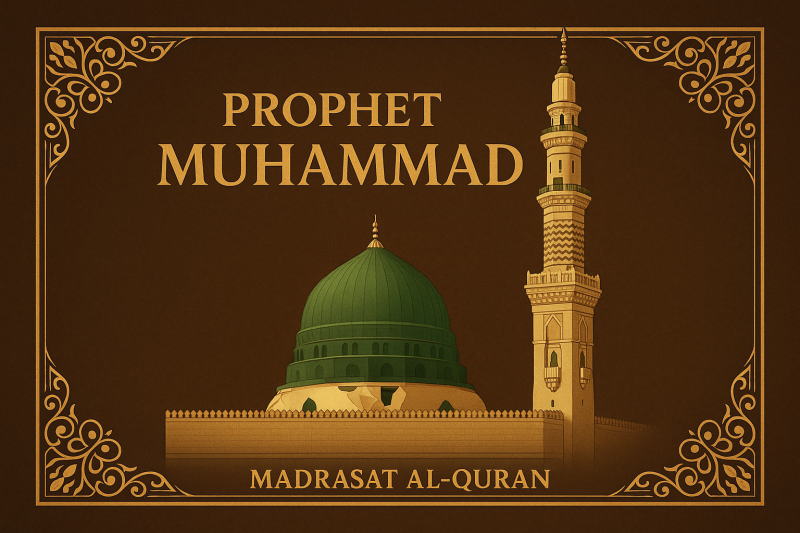
Prophet Muhammad (Peace Be Upon Him): The Final Messenger
Prophet Muhammad (peace be upon him) is the central figure of Islam and is beloved by Muslims worldwide. Born in Mecca in 570 CE, he received the revelation of the Qur’an at age 40 and dedicated his life to teaching Islam. Muslims regard him as the last and final prophet, sealing the line of prophets that began with Adam and included Abraham, Moses, and Jesus. His life exemplifies Islamic values: he emphasized faith in Allah alone, honesty, justice, mercy, and care for the weak. The Qur’an praises him as “a mercy to the worlds” (21:107), and countless Hadith highlight his kindness and humility.
Life and Message
Muhammad ﷺ taught that Islam is a complete way of life. He established five daily prayers, charity, and ethical monotheism as core practices. His Sunnah (way of life) – recorded in Hadith – provides practical examples of Qur’anic teachings. He showed deep compassion to orphans, neighbors, and even animals, embodying Allah’s attribute of mercy. In the American Muslim community, stories of the Prophet’s patience and fairness are often shared to inspire character. Children learn Hadith about treating others with kindness and honesty, reflecting his legacy.
Legacy and Impact
After the Qur’an, the sayings and actions of Muhammad ﷺ are the primary source of guidance for Muslims. As one educator notes, Muslims “strive to follow his example” because he was chosen to deliver God’s final message. His teachings laid the foundation for a cohesive community: he united warring tribes under the banner of faith and justice. Today, Muslims around the world view him as the perfect model of worship and morality. American Muslims celebrate his life (e.g. during Mawlid programs) and study his Seerah (biography) to draw spiritual lessons. His character – honesty (al-Amīn), courage, and unwavering trust in Allah – continues to guide believers in every aspect of life.
Key Takeaways: - Prophet Muhammad ﷺ is revered as Allah’s last messenger; his life and teachings complete the message of the Qur’an.
He taught universal values: monotheism, compassion, justice, and service to humanity, providing the ultimate example for Muslims to follow.
Studying his Sunnah (prayers, manners, decisions) is key to understanding Islam’s practical application in worship and daily life.
His emphasis on knowledge and mercy inspires American Muslims to pursue education and community service in the Prophet’s spirit.