

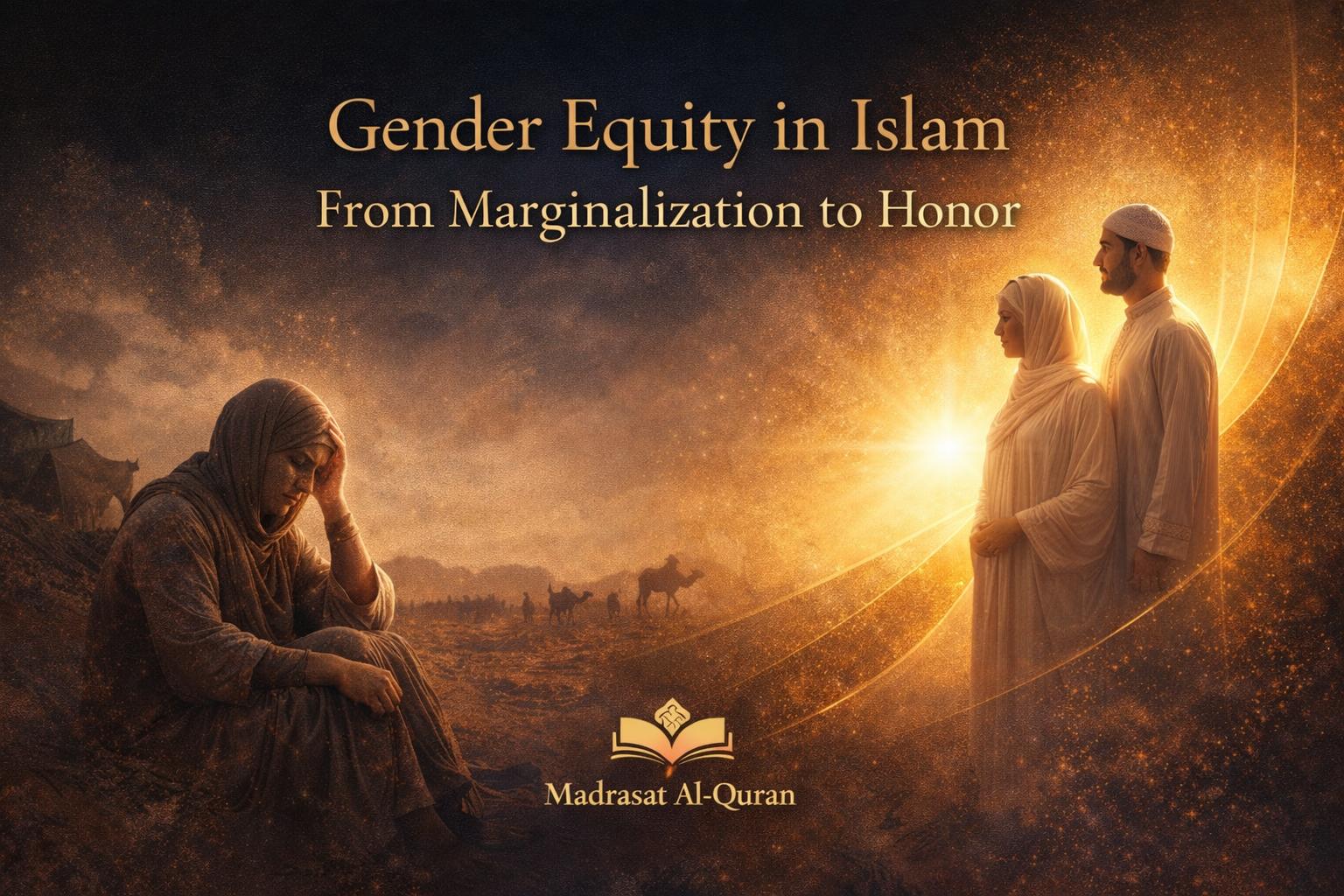
Honoring Women Through Revelation: Gender Equity in Islam
Gender Equity in Islam
From Marginalization to Honor: A Qur’anic Perspective
In today’s global conversation, few topics generate as much tension as women, faith, and gender equity. Scroll through any social platform and you will encounter bold claims: “Religion oppresses women” versus “Islam honored women centuries ago.”
For many Muslims—especially young Muslims—this debate can feel confusing and emotionally charged.
So where does Islam truly stand?
To understand Gender Equity in Islam, we must step away from modern slogans and return to something far more powerful: revelation itself.
A Society Before Revelation: When Women Were Overlooked
Pre-Islamic Arabia was not uniform. Some women held wealth or influence, but many lived under severe injustice. Their value depended heavily on tribal protection, social status, or male guardianship.
Among the harsh realities were:
Daughters being seen as a source of shame or financial burden
Women excluded from inheritance
Widows treated as property rather than individuals
Constant insecurity in a tribal, violent environment
The Qur’an captured the emotional cruelty of this mindset with striking clarity:
“When one of them is given news of a female child, his face darkens, and he is filled with grief.”
(Qur’an 16:58)
This was not merely a legal problem—it was a moral illness.
One of the most telling admissions came from a man who later became a symbol of justice in Islam: ‘Umar ibn al-Khattab (ra). He openly acknowledged that before Islam, women held little weight in society—until revelation transformed everything.
Revelation: A Radical Moral Shift
Islam did not reform society gradually through trends or cultural pressure. It restructured values at their core.
1. Spiritual Equity
The Qur’an addressed men and women together—repeatedly. Faith, righteousness, accountability, and reward were never gender-exclusive.
“Whoever does righteousness, male or female, while being a believer—We will grant them a good life.”
(Qur’an 16:97)
Worth in Islam is not measured by gender, lineage, or power, but by taqwa—God-consciousness.
This principle alone shattered centuries of spiritual hierarchy.
2. Legal and Financial Dignity
Islam anchored women’s rights not in social approval, but in divine law.
Women were granted:
The right to own and manage property
Independent financial identity
Guaranteed shares of inheritance
Protection in marriage and divorce
“For men is a share of what they earn, and for women is a share of what they earn.”
(Qur’an 4:32)
Crucially, these rights were not favors from men. They were obligations commanded by Allah.
This is a defining feature of Gender Equity in Islam:
Rights are protected by revelation, not dependent on changing social moods.
Honor Beyond Law: Transforming Attitudes
Islam did not stop at legislation—it reshaped daily behavior.
The Prophet ﷺ modeled this transformation:
He honored his daughters publicly
He showed affection and respect within the home
He normalized women’s presence in learning, worship, and community life
Practices that treated women as spiritually “unclean” or socially inferior were dismantled—not with slogans, but with example.
Equity, Not Sameness
A key misunderstanding today is confusing equity with identical roles.
Islam teaches:
Equal spiritual worth
Equal moral responsibility
Equal access to closeness to Allah
Yet it also acknowledges differences in responsibilities and roles. These differences are not signs of superiority, but part of a system designed for balance, protection, and justice.
Gender Equity in Islam is not about erasing distinctions—it is about ensuring dignity within them.
When Culture Betrays the Message
It must be said clearly:
Not everything done in the name of Islam reflects Islam.
Across cultures, harmful practices have been justified using religious language:
Denying girls education
Forcing marriages without valid consent
Silencing women in family or community matters
Excusing abuse as “tradition”
These actions are not rooted in revelation. They are deviations from it.
The solution is not abandoning faith—but returning to it with knowledge, courage, and clarity.
Education: Where True Equity Begins
Understanding Gender Equity in Islam cannot come from social media debates alone. It requires structured learning:
Qur’an, to understand how Allah speaks about justice and mercy
Seerah, to witness how the Prophet ﷺ lived these values
Fiqh, to grasp rights and responsibilities with wisdom
History, to learn from women who shaped the Ummah intellectually and morally
This is why education is not optional—it is essential.
Our Commitment at Madrasat Al-Quran
At Madrasat Al-Quran, we believe that authentic Islamic learning builds confident believers—men and women—who understand their faith beyond stereotypes and slogans.
Through structured programs in Qur’an, Islamic Studies, and foundational knowledge, we aim to reconnect learners with the original Qur’anic vision of justice, dignity, and responsibility.
Because when Islam is taught with clarity,
Gender Equity is no longer a debate—it becomes a lived value.